
 Chinese
Mold Plastic Injection: The Complete Guide to Precision Manufacturing in 2026
Mold plastic injection is one of the most widely used manufacturing processes for producing plastic parts at scale. By injecting molten plastic into a precisely engineered mold cavity, manufacturers can produce thousands — even millions — of identical components with exceptional dimensional accuracy, complex geometries, and consistent quality. From automotive interiors to medical device housings, from consumer electronics to aerospace components, mold plastic injection is the silent engine driving modern product manufacturing.
This guide covers everything you need to know about mold plastic injection in 2026: how it works, how to choose the right mold and material, what quality standards to demand, and how to select a manufacturing partner who will protect your product quality and production schedule.

What Is Mold Plastic Injection?
Mold plastic injection (also called injection moulding in British English) is a manufacturing process in which molten plastic material is forced under high pressure into a precisely machined mold (also called a tool or die). Once the plastic cools and solidifies within the mold cavity, the mold opens and the finished part is ejected — ready for use, inspection, or secondary operations.
The mold is the heart of the mold plastic injection process. It is typically made from tool steel or aluminium and consists of two halves: the cavity side (fixed half) and the core side (moving half). The precision of the mold determines the dimensional accuracy, surface finish, and mechanical properties of every part produced.
Modern mold plastic injection can produce parts ranging from a few grams to over 50 kilograms, with dimensional tolerances as tight as ±0.01 mm on critical features. It is compatible with hundreds of plastic resin grades, including commodity plastics (PP, PE, ABS), engineering plastics (PA, PC, POM, PBT), and high-performance polymers (PEEK, PPS, LCP).
The Mold Plastic Injection Process: Step by Step
Understanding the mold plastic injection cycle helps you identify optimization opportunities at every stage:
- Mold Closing — The two halves of the mold are brought together by the clamping unit. The required clamping force (typically 3–10 tons per square inch of projected part area) prevents flash and part defects.
- Plastic Injection — Granular plastic resin is melted in the barrel (typically at 200–300°C depending on the material) and injected into the closed mold cavity at high speed and pressure (10,000–30,000 psi).
- Packaging & Dwelling — Additional material is packed into the cavity to compensate for volumetric shrinkage as the plastic cools. This stage is critical for achieving dimensional accuracy.
- Cooling — Circulating coolant (water or oil) removes heat from the mold, solidifying the part. Cooling accounts for 50–80% of the total cycle time.
- Mold Opening — The core and cavity halves separate, and ejector pins push the solidified part out of the cavity.
- Part Removal — The part is removed from the mold, inspected, and placed in a collection bin or on a conveyor for secondary operations.
The total cycle time ranges from as little as 3 seconds for simple, thin-walled parts to 2–5 minutes for large, thick-walled components. All-electric injection moulding machines offer ±0.01-second repeatability, delivering exceptional consistency across millions of cycles.
Mold Design: The Foundation of Quality Mold Plastic Injection
The quality of the mold determines the quality of every part. Poor mold design leads to warpage, short shots, flash, sink marks, and dimensional instability — problems that cannot be corrected in production, only prevented at the design stage.
Key Mold Design Considerations
- Gate Design — The gate controls how molten plastic enters the cavity. Common types include direct sprue, edge gate, fan gate, submarine gate, and hot runner gate. Gate size and location directly affect filling balance, weld lines, and part aesthetics.
- Runner System — The runner delivers molten plastic from the sprue to the gate(s). Hot runner systems eliminate the solid runner, reducing material waste and cycle time. Cold runner systems are simpler and lower-cost.
- Cooling System — Effective cooling channels are essential. Baffles, bubblers, and conformal cooling (produced via 3D printing) optimize coolant flow and reduce cooling time by 15–30%.
- Draft Angle — A draft angle (typically 0.5–2 degrees per side) allows the part to release from the mold without sticking or scratching.
- Wall Thickness — Uniform wall thickness (within 10–25% variation) minimizes sink marks and warpage. Thick sections cool more slowly and can cause internal voids.
- Undercuts & Side Actions — Features that undercut the mold direction require sliders, lifters, or collapsible cores — increasing mold complexity and cost.
- Surface Finish — VDI grades, SPI finishes, or mirror polish for optical components. Textured surfaces (laser-etched, EDM, chemical) add aesthetics and hide cosmetic defects.
About SHINY Mold
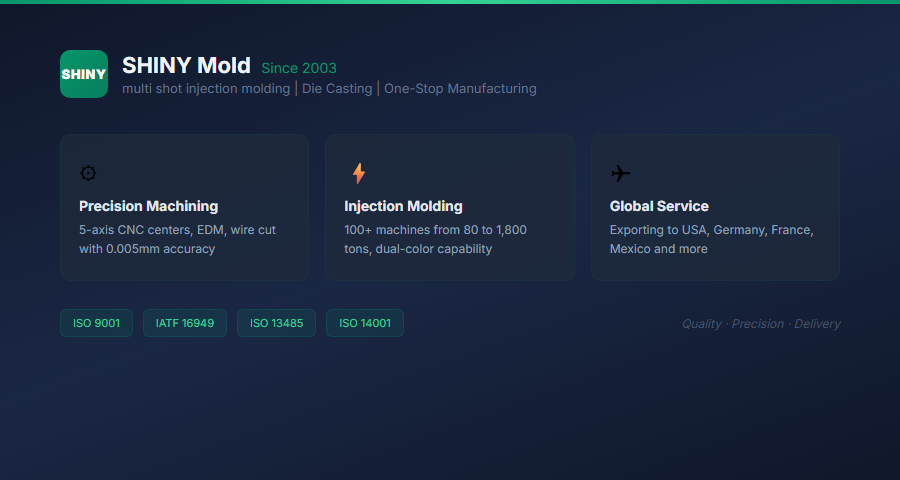
Founded in 2003, SHINY (Dongguan Xinxuan Mold) is headquartered in China's mould manufacturing hub — Chang'an, Dongguan. With fixed assets of USD 5 million, a facility spanning over 23,000 square metres, and a workforce of 400+ employees, SHINY specialises in high-precision plastic injection moulds, aluminium die-casting moulds, and magnesium die-casting moulds.
Backed by a comprehensive library of 5,000+ mould designs, SHINY delivers over 2,000 moulds annually. Our products serve industries including automotive, new energy, medical devices, consumer electronics, home appliances, power tools, and lighting. With 100+ injection moulding machines (80–1,800 tons), dual-colour injection capability, and dedicated assembly lines, SHINY provides end-to-end manufacturing from product design and prototyping to mould development, injection moulding, and finished product assembly.
SHINY is certified under ISO 9001, ISO 14001, ISO 13485, and IATF 16949 quality management systems. Our clients span the United States, Canada, Mexico, Germany, France, Poland, and other European and American markets.
Materials for Mold Plastic Injection
Material selection is one of the most consequential decisions in mold plastic injection. The right material balances mechanical properties, chemical resistance, thermal performance, aesthetics, and cost.
| Material | Properties | Applications |
|---|---|---|
| ABS | Good impact resistance, excellent surface finish, easy to paint and plate | Automotive dashboards, consumer electronics housings, toys |
| Polypropylene (PP) | Chemical resistance, living hinge capability, low density, food-safe grades | Food containers, battery cases, packaging caps, living hinges |
| Polycarbonate (PC) | High impact strength, optical clarity, heat resistance up to 135°C | Automotive lenses, safety glasses, LED lenses, medical devices |
| Nylon / PA | High tensile strength, wear resistance, heat resistance, good chemical resistance | Gears, bearings, automotive engine components, fasteners |
| POM (Acetal/Delrin) | Excellent dimensional stability, low friction, high stiffness, creep resistance | Precision gears, fuel system components, conveyor parts |
| PBT | Good electrical insulation, chemical resistance, dimensional stability | Electrical connectors, sensor housings, LED frames, automotive connectors |
| PEEK | Extreme temperature resistance (up to 250°C), chemical inertness, biocompatibility | Aerospace components, medical implants, oil & gas equipment |
| PMMA (Acrylic) | Optical clarity, UV resistance, scratch resistance, excellent surface gloss | Lenses, display panels, automotive lighting, signage |
Types of Molds for Plastic Injection
Prototype Molds (Soft Tools)
For early-stage validation and low-volume production (50–1,000 pieces), prototype molds made from aluminium or soft steel offer rapid lead times (2–4 weeks) at significantly reduced cost. 3D-printed mold inserts enable even faster validation with turn-around times of days rather than weeks.
Production Molds (Hard Tools)
For high-volume production (10,000+ pieces), production molds made from P20, H13, or S136 tool steel are engineered for durability (500,000–2,000,000+ cycles). Multi-cavity production molds (2, 4, 8, 16, 32+ cavities) amortize the mold cost across millions of parts, dramatically reducing the piece price.
Hot Runner Molds
Hot runner systems keep the plastic molten in the runner channels, eliminating the solid runner and sprue that must be recycled in cold runner molds. Benefits include zero runner waste, faster cycle times, better part quality, and reduced material cost — though the mold is more expensive to manufacture.
Family Molds
A family mold produces multiple different parts (or part variations) in a single mold. This approach is ideal for products with multiple components made from the same material and with similar wall thickness. It reduces equipment requirements and floor space but requires careful balancing of fill times across all cavities.
Quality Control in Mold Plastic Injection
Consistent quality in mold plastic injection requires rigorous controls throughout the entire process:
- Mold Trial & Validation — First Article Inspection (FAI), CMM measurement, and dimensional reporting on T1 (first trial) samples before production release
- Process Monitoring — Scientific Moulding principles with critical process parameters (injection speed, pressure, temperature, cooling time) locked within proven windows
- Statistical Process Control (SPC) — Real-time monitoring of critical dimensions with control charts (X-bar, R charts) to detect process drift before it produces defective parts
- Visual Inspection — Automated vision systems detect surface defects, flash, gate marks, and color variations at production speeds
- Material Certification — Raw material certificates (MTRs) confirming resin grade, lot number, MFI (Melt Flow Index), and mechanical properties
- PPAP (Production Part Approval Process) — Required by automotive OEMs, PPAP includes dimensional reports, material certifications, process flow diagrams, PFMEA, control plans, and process capability studies (CPK ≥ 1.33 for critical characteristics)
Cost Drivers in Mold Plastic Injection
Understanding what drives mold plastic injection costs helps you optimize your project budget:
Mold Investment (One-Time Cost)
- Complexity — Undercuts, slides, lifters, and intricate core/cavity geometry increase machining time and cost
- Cavity Count — Multi-cavity molds produce more parts per cycle, but require higher clamping force and more precise balance
- Mold Material — Aluminium ($5,000–$20,000) for prototypes vs. P20 ($15,000–$80,000) for production steel vs. S136 ($30,000–$150,000) for mirror-finish or high-polish requirements
- Lead Time — Standard (6–10 weeks) vs. expedited (3–5 weeks, +30–60% premium)
- Surface Finish — Standard polish is included; custom textures, VDI grades, or EDM finishes add cost
Piece Price (Per-Part Cost)
- Material Cost — Commodity resins ($1–3/kg) vs. engineering resins ($5–20/kg) vs. high-performance polymers ($50–500/kg)
- Part Weight & Size — Directly correlates to material consumption and required machine tonnage
- Cycle Time — Every second of cycle time adds to the cost; cooling optimization can reduce cycle time by 20–40%
- Secondary Operations — Printing, coating, ultrasonic welding, assembly, and packaging add to the piece price
- Tolerance & Inspection Level — Tight tolerances require higher-precision molds, more inspection, and higher scrap rates
How to Choose a Mold Plastic Injection Supplier
Selecting the right mold plastic injection partner is critical. Use this checklist to evaluate potential suppliers:
- In-House Tool Room — Do they manufacture their own molds, or do they outsource? In-house tooling enables faster iterations, better quality control, and lower communication friction.
- CAE Simulation — Do they use Moldflow, Moldex3D, or similar CAE tools to validate mold design before cutting steel? Simulation prevents costly mold modifications.
- Quality Certifications — ISO 9001 (minimum), IATF 16949 (automotive), ISO 13485 (medical devices). Verify through a current certificate, not just a claim.
- Machine Fleet — What tonnage range do they have? Do they offer the machine sizes your parts require? Can they handle your production volume?
- Industry Experience — Request case studies and customer references in your industry. A mold plastic injection supplier with 20 years of automotive experience will understand PPAP, FMEA, and APQP requirements.
- Communication & Responsiveness — Do they respond to RFQs within 24 hours? Do they provide DFM feedback proactively? Poor communication early on predicts worse problems later.
- Prototype Capability — Can they support rapid prototyping to validate your design before committing to production tooling?
2026 Trends in Mold Plastic Injection
AI & Machine Learning in Process Optimization
Leading mold plastic injection manufacturers are deploying AI-driven process optimization systems that analyze thousands of process variables in real time, automatically adjusting parameters to maintain peak quality and minimize scrap. These systems learn from historical production data and can predict defects before they occur.
Additive Manufacturing for Mold Components
3D-printed conformal cooling channels, soft mold inserts, and rapid tooling are becoming mainstream in mold plastic injection. Additive manufacturing enables cooling geometries impossible to machine conventionally, reducing cycle times by 15–30% and improving part quality.
Sustainability & Circular Economy
The mold plastic injection industry is responding to sustainability demands through recycled and bio-based resins, all-electric machines (which use 30–50% less energy than hydraulic machines), closed-loop material recovery systems, and mold design for disassembly and recycling.
Medical & Healthcare Molding
Strict regulatory requirements (FDA 21 CFR Part 820, EU MDR) and growing demand for drug delivery devices, diagnostic equipment, and surgical instruments are driving investment in cleanroom molding (ISO Class 7/8), validated processes, and ISO 13485-certified quality management systems.
Common Defects in Mold Plastic Injection & How to Prevent Them
- Warping — Caused by uneven cooling, excessive shear, or poor mold design. Prevention: uniform wall thickness, optimized cooling, adequate clamping force, proper gate location.
- Sink Marks — Visible depressions on the part surface caused by volumetric shrinkage in thick sections. Prevention: add ribs and gussets, increase packing pressure, use low-shrinkage resins.
- Flash — Thin web of plastic at the mold parting line. Prevention: ensure adequate clamping force, inspect and maintain the mold, reduce injection pressure.
- Short Shots — Incomplete part filling. Prevention: increase injection pressure/speed, raise melt temperature, check for blocked vents or gates.
- Weld Lines — Visible lines where two or more flow fronts meet. Prevention: raise melt temperature, optimize gate location, use流动性更好的材料.
- Bubbles / Voids — Internal gas pockets. Prevention: reduce moisture content (dry materials properly), lower injection speed, increase back pressure.
Frequently Asked Questions
What is the difference between a mold and a tool in injection molding?
In the plastic injection molding industry, "mold" and "tool" are synonymous. Both refer to the precision-machined device that defines the shape of the plastic part. Some companies use "tool" to refer specifically to the production mold and "mold" for the prototype or low-volume version.
How long does it take to manufacture a mold for plastic injection?
Prototype molds: 2–4 weeks. Standard production molds: 6–10 weeks. Complex, multi-cavity, or high-precision molds: 10–16 weeks. Expedited tooling is available at a premium cost (typically +30–60%).
What is the minimum order quantity for mold plastic injection?
MOQs vary by supplier. Some offer low-volume production runs of 100–500 pieces using aluminium or prototype molds. For production volumes of 1,000–5,000+ pieces per year, a standard steel production mold is more cost-effective.
How do I prevent warpage in large plastic parts?
Warpage prevention strategies include: uniform wall thickness design, symmetric ribbing, minimizing the temperature differential between core and cavity, using fiber-reinforced resins with low mold shrinkage, and applying科学的模具冷却分析. Proper packing and holding pressure during injection also significantly reduces residual stress and warpage.
Can mold plastic injection produce parts with metal inserts?
Yes. Insert molding (or overmolding) embeds metal components such as threaded inserts, brass bushings, or stamped metal parts into the plastic during injection. This eliminates secondary assembly operations and produces a unified part with both plastic and metal features.
What surface finishes are available for mold plastic injection?
Standard surface finishes range from SPI A-1 (Grade #1, diamond polish) to SPI D-3 (dragged finish). Common options include: standard polish, high-gloss polish, semi-gloss, matte, VDI texture grades (VDI 12, VDI 22, VDI 34, etc.), laser-etched textures, and EDM finishes for non-reflective surfaces.
Conclusion
Mold plastic injection remains the most versatile and cost-effective method for high-volume plastic manufacturing in 2026. The quality of your finished parts is fundamentally determined by the quality of your mold design, the rigor of your process control, and the competence of your manufacturing partner.
By understanding the fundamentals outlined in this guide — mold design principles, material selection, quality standards, and supplier evaluation criteria — you are better equipped to make informed decisions that protect your product quality, control your costs, and accelerate your time to market.
Whether you are producing 100 prototypes for design validation or 10 million parts for a global product launch, the principles of precision mold design, rigorous process control, and continuous improvement apply at every scale. Partner with a mold plastic injection specialist who shares your commitment to quality — and your products will reflect that excellence in every unit.