
 Chinese
Injection Molding Machine: The Complete Guide to Selection & Operation in 2026
An injection molding machine is the heart of any plastic injection molding operation. Whether you are setting up a new production line, upgrading existing equipment, or sourcing parts from a contract manufacturer, understanding injection molding machines is essential for making informed decisions about quality, cost, and production efficiency.
This comprehensive guide covers everything you need to know about injection molding machines in 2026: machine types, key specifications, leading manufacturers, selection criteria, and emerging technologies that are reshaping the industry.
What Is an Injection Molding Machine?
An injection molding machine (also called an injection press) is a manufacturing machine that injects molten plastic material into a mold cavity, where it cools and solidifies into the desired shape. The machine consists of two main units:
- Injection Unit — Heats plastic granules to molten state and injects them into the mold under high pressure
- Clamping Unit — Holds the mold closed against the injection pressure and opens/closes the mold for part ejection
Types of Injection Molding Machines
1. Hydraulic Injection Molding Machines
Traditional hydraulic machines use hydraulic oil to power both the injection and clamping units. They are robust, cost-effective, and suitable for most standard applications.
- Pros: Lower upfront cost, high reliability, suitable for large machines (500T+)
- Cons: Higher energy consumption, slower cycle times, more maintenance
- Best for: Large-tonnage applications, cost-sensitive operations
2. All-Electric Injection Molding Machines
All-electric machines use servo motors instead of hydraulics. They deliver superior precision, energy efficiency, and cleanroom compatibility.
- Pros: High precision (±0.02mm), energy savings (30-70%), clean operation (no oil), faster cycle times
- Cons: Higher upfront cost, limited to smaller tonnages (typically <650T)
- Best for: Medical, optical, cleanroom, and high-precision applications
3. Hybrid (Electric-Hydraulic) Injection Molding Machines
Hybrid machines combine electric injection with hydraulic clamping, or vice versa, to balance performance and cost.
- Pros: Good balance of precision and cost, energy savings vs. full hydraulic
- Cons: More complex, requires both hydraulic and electrical maintenance
- Best for: Medium-precision applications with cost constraints
4. Multi-Component (Multi-Shot) Injection Molding Machines
These machines have two or more injection units for molding different materials or colors in a single cycle (e.g., overmolding, two-shot molding).
- Pros: Enables complex multi-material parts, reduces assembly steps
- Cons: Higher machine cost, more complex tooling
- Best for: Soft-touch grips, sealed assemblies, multi-color parts
Key Specifications When Selecting an Injection Molding Machine
| Specification | What It Means | Typical Range |
|---|---|---|
| Clamping Force (Tons) | Maximum force the clamping unit can apply to keep the mold closed | 30T – 4,000T+ |
| Shot Size (grams) | Maximum volume of plastic that can be injected in one shot | 10g – 50,000g+ |
| Screw Diameter (mm) | Diameter of the injection screw; affects shear rate and plasticizing capacity | 18mm – 180mm |
| Injection Pressure (bar) | Maximum pressure applied to inject molten plastic into the mold | 1,500 – 2,500 bar |
| Tie Bar Spacing (mm) | Maximum mold size that can fit between the tie bars | 200×200 – 2,000×2,000mm |
| Mold Height (mm) | Minimum and maximum mold thickness the machine can accommodate | 150 – 1,200mm |
| Dry Cycle Time (sec) | Fastest possible cycle without injection (indicates machine speed) | 1.0 – 10.0 sec |
How to Choose the Right Injection Molding Machine
Step 1: Determine Required Clamping Force
Clamping force is the primary specification for machine selection. A common rule of thumb:
Required Clamping Force (tons) = Projected Part Area (cm²) × Safety Factor (0.3 – 0.5)Example: A part with 200 cm² projected area requires approximately 60–100 tons of clamping force.
Step 2: Verify Shot Size & Plasticizing Capacity
Ensure the machine's shot size can accommodate your part weight (including runner and sprue) with 10-30% margin. Also verify the plasticizing capacity (kg/hr) matches your cycle time requirements.
Step 3: Check Platen Size & Tie Bar Spacing
Your mold must fit within the machine's platen dimensions and tie bar spacing. Always allow at least 50mm clearance on each side.
Step 4: Evaluate Machine Type (Hydraulic vs. Electric vs. Hybrid)
- High precision / cleanroom: Choose all-electric
- Large parts (500T+): Hydraulic is often the only option
- Balanced performance: Consider hybrid
Step 5: Consider Future Flexibility
Choose a machine with slightly more capacity than your current needs to accommodate future projects and mold variations.
Leading Injection Molding Machine Manufacturers (2026)
| Manufacturer | Headquarters | Specialization |
|---|---|---|
| Arburg | Germany | Precision all-electric, modular machines |
| Engel | Austria | All-electric, hybrid, automation integration |
| KraussMaffei | Germany | Large hydraulic machines, automotive |
| Sumitomo (SHI) Demag | Japan/Germany | All-electric, high-speed, precision |
| Haitian | China | Cost-effective hydraulic and hybrid machines |
| Chen Hsong | Hong Kong/China | Hydraulic machines, Asia market leader |
| Nissei | Japan | All-electric, high-precision, medical |
| Wittmann Battenfeld | Austria | All-electric, cleanroom, medical |
About SHINY Mold
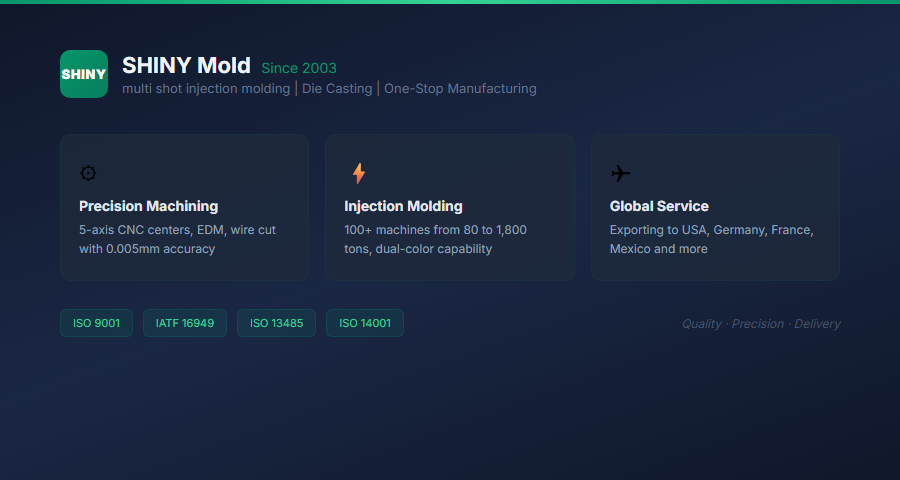
Founded in 2003, SHINY (Dongguan Xinxuan Mold) is headquartered in China's mould manufacturing hub — Chang'an, Dongguan. With fixed assets of USD 5 million, a facility spanning over 23,000 square metres, and a workforce of 400+ employees, SHINY specialises in high-precision plastic injection moulds, aluminium die-casting moulds, and magnesium die-casting moulds.
Backed by a comprehensive library of 5,000+ mould designs, SHINY delivers over 2,000 moulds annually. Our products serve industries including automotive, new energy, medical devices, consumer electronics, home appliances, power tools, and lighting. With 100+ injection moulding machines (80–1,800 tons), dual-colour injection capability, and dedicated assembly lines, SHINY provides end-to-end manufacturing from product design and prototyping to mould development, injection moulding, and finished product assembly.
SHINY is certified under ISO 9001, ISO 14001, ISO 13485, and IATF 16949 quality management systems. Our clients span the United States, Canada, Mexico, Germany, France, Poland, and other European and American markets.
Injection Molding Machine Price Ranges (2026)
| Machine Type | Tonnage | Price Range (USD) |
|---|---|---|
| Entry-level hydraulic | 50-100T | $15,000 – $35,000 |
| Mid-range hydraulic | 100-350T | $35,000 – $120,000 |
| High-end hydraulic | 350-1,000T | $120,000 – $500,000 |
| All-electric (precision) | 50-300T | $50,000 – $300,000 |
| Two-shot / Multi-shot | 100-650T | $100,000 – $600,000 |
| Large hydraulic (automotive) | 1,000-4,000T | $500,000 – $2,500,000+ |
Note: Prices vary significantly by brand, configuration, and regional market. Always request multiple quotes and evaluate total cost of ownership (TCO), not just upfront price.
2026 Trends in Injection Molding Machines
Industry 4.0 & IoT Integration
Modern injection molding machines come equipped with IoT sensors that monitor process parameters in real time: injection pressure, melt temperature, cooling time, and cycle time. This data enables predictive maintenance, process optimization, and quality assurance through Statistical Process Control (SPC).
Energy Efficiency & Sustainability
All-electric machines consume 30-70% less energy than hydraulic machines. In 2026, energy efficiency is a key selection criterion, driven by both cost savings and environmental regulations. Leading manufacturers now provide energy consumption data per kg of molded parts.
AI-Driven Process Optimization
Machine learning algorithms are being integrated into machine controllers to automatically optimize process parameters (temperature, pressure, speed) based on material properties, part geometry, and quality requirements. This reduces setup time and scrap rate.
Collaborative Robots (Cobots) Integration
Injection molding machines are increasingly integrated with cobots for part removal, insert loading, assembly, and packaging. Cobots improve safety, reduce labor costs, and enable lights-out manufacturing.
Maintenance Best Practices for Injection Molding Machines
- Daily Checks
- Check hydraulic oil level and temperature (hydraulic machines)
- Verify cooling water flow and temperature
- Inspect nozzle and heater bands
- Weekly Maintenance
- Lubricate moving parts (tie bars, toggle joints)
- Clean hopper and feed throat
- Check screw wear (measure recovery time)
- Monthly Maintenance
- Test safety interlocks and emergency stop
- Check hydraulic filters and pressure relief valves
- Inspect electrical connections and heater bands
- Annual Overhaul
- Full hydraulic system flush and filter replacement
- Screw and barrel wear measurement
- Clamping force calibration
- Controller software updates
Frequently Asked Questions
What size injection molding machine do I need?
The required clamping force depends on the projected area of your part. A general rule: 2–5 tons per square inch of projected area. Consult with your mold designer or use Moldflow simulation for precise calculation.
Hydraulic vs. all-electric: which is better?
All-electric machines offer superior precision, energy efficiency, and clean operation but cost more upfront. Hydraulic machines are more cost-effective for large tonnages. Choose based on your part requirements, production volume, and budget.
How long do injection molding machines last?
With proper maintenance, injection molding machines can operate for 15-25 years. Key wear components (screw, barrel, seals) may need replacement every 3-7 years depending on usage and material type.
Can I retrofit my old injection molding machine?
Yes. Retrofitting options include upgrading the controller (CNC system), replacing hydraulic components with servo motors (semi-electric retrofit), and adding IoT sensors for process monitoring. Retrofitting typically costs 20-40% of a new machine.
What is the lead time for a new injection molding machine?
Standard machines: 8-16 weeks. Custom configurations or large tonnages: 20-40 weeks. Plan your capacity expansion accordingly and consider ordering machines in parallel with mold fabrication to minimize downtime.
Conclusion
Choosing the right injection molding machine is a strategic investment that impacts product quality, production efficiency, and long-term profitability. By understanding machine types, key specifications, and total cost of ownership, you can make an informed decision that aligns with your production needs and business goals.
Whether you are investing in your own machines or partnering with a contract manufacturer, prioritize precision, reliability, and after-sales support. In 2026, the most successful injection molding operations will be those that embrace Industry 4.0 technologies, energy efficiency, and continuous process optimization.
At SHINY Mold, we operate 100+ injection molding machines (80–1,800 tons) and provide turnkey injection molding services with ISO 9001, IATF 16949, and ISO 13485 certifications. Contact us to discuss your project requirements and discover how our technical expertise can support your success.