
 Chinese
Injection Mold Design: The Complete Guide to Precision Tooling in 2026
Whether you're an engineer commissioning your first custom mold or a procurement manager sourcing injection mold design services, understanding how injection molds are designed is the foundation of getting quality plastic parts at competitive prices.
Great injection mold design isn't just about geometry — it's about predicting how molten plastic will flow, cool, and shrink inside a steel cavity, then engineering a tool that can reproduce that process thousands of times with zero deviation on critical dimensions.
This guide walks you through the complete injection mold design process — from initial DFM review to final tool delivery — so you can make informed decisions about your tooling project in 2026.

What Is Injection Mold Design?
Injection mold design is the engineering process of creating the detailed drawings and specifications for the steel or aluminum tooling that shapes molten plastic into finished parts. A well-designed mold ensures that every shot produces parts that meet dimensional tolerances, surface finish requirements, and cosmetic standards — cycle after cycle.
The injection mold design process covers:
- Parting line and split-plane definition
- Cavity and core layout with proper ejection draft angles
- Gating system design (sprue, runner, gate location and type)
- Cooling channel layout for uniform heat removal
- Vent and air escape pathway engineering
- Ejector pin and stripper plate system design
- Structural calculations for mold base and cavity plate deflection
- Material selection for mold components
Key Stages of the Injection Mold Design Process
Stage 1: Design for Manufacturability (DFM) Review
Before any steel is cut, a professional injection mold design engineer reviews the 3D CAD model to identify potential production issues. This DFM stage is arguably the most valuable step in the entire mold-making process — catching a design flaw on paper costs $50; catching it during trial-and-error machining costs thousands.
A thorough DFM review addresses:
- Wall thickness uniformity — Uniform wall thickness prevents sink marks and warpage. The recommended range is 1.0–4.0mm for most consumer products.
- Draft angles — All vertical surfaces need draft (taper) for clean part ejection. Typical values: 0.5°–2.0° per side, depending on surface texture depth.
- Undercuts — Features that lock the part into the cavity require side actions (lifters, sliders) or must be redesigned.
- Gate location — Gate placement directly affects flow patterns, weld lines, air traps, and cosmetic appearance.
- Parting line position — The split between A-plate and B-plate should be on a flat or masked surface, never across a visible cosmetic face.
- Draft and dimensional tolerances — Tighter tolerances require higher-precision machining and potentially more expensive tool steel.
Stage 2: Mold Flow Analysis (CAE Simulation)
Modern injection mold design relies heavily on mold flow simulation software (Moldflow, Moldex3D) to predict plastic flow behavior before cutting steel. This virtual trial catches problems that are impossible to see on a CAD model:
- Flow front analysis — Does the plastic fill the cavity completely without air traps or short shots?
- Weld line location — Where will flow fronts meet? Weld lines are structurally weaker and cosmetically visible.
- Pressure distribution — Are there high-pressure zones that could cause flash or cavity deflection?
- Cooling efficiency — Are cooling channels optimally placed? Uneven cooling causes warpage and dimensional drift.
- Shrinkage prediction — Material-specific shrinkage compensation is applied to the CAD model before machining.
At SHINY Mold, every production mold undergoes mold flow analysis as standard practice, reducing trial iterations by 30–50% and ensuring first-shot quality for clients in automotive, medical, and consumer electronics industries.
Core Elements of Injection Mold Design
1. Parting Line Design
The parting line is the boundary where the two halves of the mold (cavity and core) meet. Proper parting line design minimizes flash, ensures clean part appearance, and simplifies machining.
Best practices:
- Place the parting line on a non-cosmetic surface whenever possible
- Keep the parting line as short as possible to minimize flash risk
- Use a stepped or angled parting line for complex contours
- Ensure the parting line is accessible for post-machining finishing
2. Gating System Design
The gate is the small opening through which molten plastic enters the cavity. Gate design directly impacts part quality, cycle time, and production cost.
| Gate Type | Best For | Considerations |
|---|---|---|
| Edge gate | Single-cavity molds, large parts | Simple, low cost, easy to machine |
| Submarine (tunnel) gate | Multi-cavity, automated production | Gate shears off automatically; no sprue mark |
| Pin gate (hot runner) | High-volume, cosmetic parts | No cold runner waste; requires hot runner system |
| Fan gate | Thin-wall parts, large flat surfaces | Uniform flow distribution; larger gate witness |
| Diaphragm gate | Circular or cylindrical parts | Full circumference entry; balanced fill |
3. Cooling Channel Design
Cooling accounts for 50–75% of the total injection molding cycle time. Optimized injection mold design for cooling can dramatically reduce production costs:
- Baffle and bubbler systems — For cores with limited space, conformal cooling channels (3D-printed in tool steel) offer 20–40% faster cycle times vs. conventional drilling
- Cooling balance — All cavities should cool at the same rate to ensure dimensional consistency across multi-cavity molds
- Thermocouple placement — Temperature sensors positioned at critical locations feed back to the molding machine controller for process stability
- Water knockout zones — Proper drainage prevents water carryover into the mold cavity
4. Ejection System Design
Once the part solidifies, it must be ejected cleanly without deformation:
- Ejector pins — Standard hardened steel pins push the part off the core; pin placement avoids cosmetic surfaces
- Stripper plates — For parts with deep draws or fragile geometries, a stripper plate pushes the part off the core
- Air ejection — Compressed air assists in releasing vacuum-suction parts, especially for deep-cavity components
- Unscrewing mechanisms — For parts with internal threads, the mold includes a rotating unscrewing core driven by the machine's rotation
Injection Mold Design Software in 2026
The most widely used CAD/CAM platforms for injection mold design include:
- SolidWorks Mold Toolbox / Injection Molding Wizard — Entry-level mold design for simple parts
- Siemens NX (Mold Designer) — Professional-grade, parametric mold design with full PMI support
- Catia (Mold Tooling) — High-end aerospace and automotive tooling design
- Autodesk Moldflow Insight — Industry-standard CAE for injection mold filling, cooling, and warpage simulation
- Moldex3D — Advanced 3D simulation for complex geometries, multi-material, and overmolding analysis
At SHINY Mold, our engineering team uses a combination of SolidWorks, NX, and Autodesk Moldflow to design molds ranging from simple 2-cavity tools to complex 32-cavity family molds with hot runners and multi-action unscrewing mechanisms.
Mold Materials and Surface Treatment
Mold Steel Selection
| Steel Type | Applications | Hardness | Cycle Life |
|---|---|---|---|
| P20 pre-hardened | Prototype, low-volume production | 28–32 HRC | ~100,000 shots |
| H13 tool steel | High-volume production, engineering plastics | 44–48 HRC | ~500,000 shots |
| S136 stainless | Optical, medical, food-grade parts | 48–52 HRC | 500,000+ shots |
| Aluminum 7075-T6 | Rapid tooling, soft molds, <5,000 shots | N/A (Al) | ~5,000 shots |
| NAK80 mirror steel | High-polish, cosmetic surface molds | 36–42 HRC | 200,000+ shots |
Surface Treatments
- Nitriding — Surface hardening for wear resistance in runner systems and core/cavity inserts
- TiN (Titanium Nitride) coating — Reduces friction on ejector pins and sliding surfaces
- Electroless Nickel plating — Corrosion resistance for molds processing PVC or other corrosive materials
- Mirror polishing — Required for transparent parts and high-gloss cosmetic surfaces
- Texturing (VDI 3400, SPI) — For matte finishes, anti-scratch surfaces, and brand-aligned textures
Injection Mold Design Tolerances and Precision
Injection molded part tolerances are typically held to ±0.02mm per 25mm of dimension for standard production. Factors affecting achievable tolerances:
- Mold manufacturing precision — CNC machined molds hold ±0.01mm; hand-polished cavities may vary ±0.05mm
- Material shrinkage variation — Amorphous vs. semi-crystalline materials behave differently; specific shrinkage compensation is model-specific
- Part geometry — Long, thin sections warp more than thick, ribbed sections
- Processing conditions — Melt temperature, injection speed, and packing pressure all affect final dimensions
- Environmental conditions — Humidity and temperature affect hygroscopic materials like nylon (PA6, PA66)
About SHINY Mold — Precision Mold Design & Manufacturing
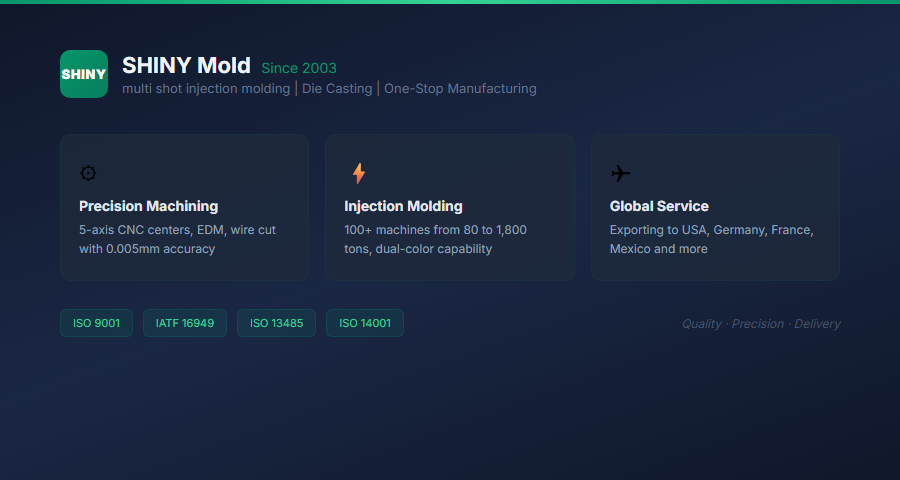
Founded in 2003, SHINY (Dongguan Xinxuan Mold) is headquartered in Chang'an, Dongguan — China's premier mold manufacturing hub. With fixed assets of USD 5 million, a 23,000+ square metre facility, and 400+ skilled employees, SHINY specializes in high-precision plastic injection molds, aluminum die-casting molds, and magnesium die-casting molds.
Our facility features 100+ injection molding machines ranging from 80 to 1,800 tons, dual-colour injection capability, and dedicated clean room molding areas. With a design library of 5,000+ successful mold designs and annual output of 2,000+ molds, we serve clients across automotive, new energy, medical devices, consumer electronics, home appliances, power tools, and lighting industries.
SHINY is certified under ISO 9001:2015, ISO 14001:2015, ISO 13485:2016, and IATF 16949:2016. Our export markets include the United States, Canada, Mexico, Germany, France, Poland, and throughout Europe.
Common Injection Mold Design Mistakes to Avoid
- Insufficient draft angle — Parts stick in the cavity, causing damage during ejection and shortened mold life
- Non-uniform wall thickness — Causes sink marks on thick sections and voids on thin sections
- Gate located on a cosmetic surface — Gate vestige (gate mark) is visible and unacceptable on finished parts
- Inadequate cooling — Long cycle times, warpage, and dimensional instability
- Ignoring ejection draft — Forgetting that both halves of the mold require draft on vertical walls
- Weld line near functional features — Weld lines are structurally weak and should not cross load-bearing sections
- Underestimating undercuts — Side-action cores add significant cost; redesigning to eliminate undercuts is often more economical
- No draft on textured surfaces — Textures require additional draft angle (typically +0.5°–1.0° per 0.025mm texture depth)
Injection Mold Design Cost Breakdown
Understanding where your injection mold design and tooling budget goes helps in planning and negotiation:
| Cost Component | % of Total Mold Cost | Notes |
|---|---|---|
| Cavity & Core machining | 30–40% | Most critical — determines part quality |
| Mold base & structure | 20–25% | Standardized components where possible |
| Cooling system | 10–15% | Optimized channels reduce cycle time significantly |
| Ejection system | 5–10% | Standard pins + custom solutions |
| Surface treatment | 5–10% | Texturing, coating, polishing |
| Hot runner (if applicable) | 15–30% | Higher upfront cost, lower per-part cost |
| Mold trials & samples | 5–10% | T1/T2 trials, dimensional reports, PPAP |
How Long Does Injection Mold Design and Build Take?
Typical timelines for professional injection mold design and tooling:
- DFM & Mold Flow Analysis: 3–5 business days
- 2D tooling drawings: 2–3 business days
- CNC machining (cavity/core): 10–25 days (varies with complexity)
- EDM and finishing: 5–10 days
- Assembly and first trial: 3–5 days
- T1 sample, modification, T2 sample: 7–14 days
- Total: 30–60 days (typical production mold); 15–25 days (rapid/soft tooling)
Frequently Asked Questions
What is the ideal wall thickness for injection molding?
Recommended wall thickness for most injection molded parts is 1.0–3.0mm. Uniform thickness throughout the part is critical — variations exceeding 20% cause sink marks, warpage, and internal voids. Use ribs and gussets to stiffen sections without increasing wall thickness.
How much does injection mold design cost in 2026?
Professional injection mold tooling (1 cavity, standard P20 steel) ranges from USD 3,000–15,000 depending on part size, complexity, and surface finish requirements. Multi-cavity, family, and hot runner molds cost more. Prototype/rapid tooling in aluminum starts at USD 800–3,000 with faster delivery.
What's the difference between a prototype mold and a production mold?
Prototype molds (also called soft molds or rapid molds) are typically machined in aluminum or soft steel and designed for 500–5,000 shots. Production molds use hardened tool steel (H13, S136) and are engineered for 100,000–1,000,000+ cycles. Aluminum prototype molds can often be converted to hardened steel production molds by re-cutting the cavity inserts.
How do I choose the right mold maker?
Look for: (1) Relevant industry experience (automotive, medical, electronics), (2) In-house tool room with CNC, EDM, wire-cut, and CMM, (3) Mold flow simulation capability, (4) Quality certifications (ISO 9001, IATF 16949 for automotive), (5) Sample approval and PPAP documentation process, (6) Clear communication and English-speaking engineers. SHINY Mold meets all these criteria with 21+ years of export experience serving North American and European clients.
What is a family mold in injection molding?
A family mold contains multiple different part designs (cavities) in a single mold base. All parts in a family mold must be made from the same material with similar wall thickness and similar flow requirements. Family molds reduce per-part tooling costs but can increase cycle time if parts have very different cooling requirements.
Conclusion
Injection mold design is both science and art — it requires deep understanding of polymer behavior, precision engineering, and practical manufacturing experience. The quality of the mold directly determines the quality of every part you produce, the speed at which you produce it, and the cost of each unit.
Investing in professional injection mold design — with proper DFM review, mold flow simulation, and precision CNC machining — is the single most impactful decision you can make for your injection molding project. It reduces trial iterations, shortens time-to-market, and ensures that your production run delivers parts that meet specifications from shot one.
Whether you need a single-cavity prototype mold, a 32-cavity family mold for high-volume production, or a complex multi-action tool with unscrewing and hot runners, choosing a mold maker with proven design capability and international quality standards is essential.