
 Chinese
Automotive Injection Molding: Complete Guide for Car Parts Manufacturing in 2026
Automotive injection molding is the backbone of modern vehicle manufacturing, producing everything from interior trim and dashboard components to under-hood structural parts and exterior body panels. With the global automotive injection molding market projected to exceed $50 billion by 2030, understanding this technology is essential for anyone involved in automotive supply chains.
This comprehensive guide covers everything automotive professionals need to know about injection molding for car parts in 2026: materials, quality standards, manufacturing processes, cost factors, and how to select the right molding partner for your automotive project.

What Is Automotive Injection Molding?
Automotive injection molding is a specialized manufacturing process that produces plastic components for vehicles using high-pressure injection of molten polymer into precision-engineered moulds. This process delivers the high-volume production, tight tolerances, and consistent quality that the automotive industry demands.
Unlike general-purpose injection molding, automotive molding must meet stringent requirements:
- IATF 16949 certification — The automotive-specific quality management standard
- PPAP (Production Part Approval Process) — Documentation package for part approval
- Traceability — Full material and process traceability throughout production
- SPC (Statistical Process Control) — Real-time monitoring of critical parameters
- Long-term reliability — Parts must perform for 10-15+ years in harsh environments
Key Applications in the Automotive Industry
Interior Components
| Component | Typical Material | Key Requirements |
|---|---|---|
| Dashboard panels | ABS, PP, PC/ABS | Heat resistance, UV stability, surface finish |
| Door panels | PP, TPO | Impact resistance, texture consistency |
| Center console | PC/ABS, ABS | Dimensional stability, scratch resistance |
| Instrument cluster housing | PC, PC/ABS | Optical clarity, EMI shielding capability |
| HVAC vents & ducts | PP, PA | Temperature cycling, snap-fit assembly |
| Seat components | PA, POM, PP | High strength, wear resistance |
Under-Hood Components
- Air intake manifolds — PA (nylon) for high-temperature resistance and chemical resistance to fuels
- Engine covers — PA or PBT with glass fiber reinforcement for structural rigidity
- Coolant reservoirs — PA or PP for chemical resistance and temperature cycling
- Connector housings — PBT or PA for electrical insulation and dimensional stability
- Fuel system components — HDPE, POM, or PA for fuel resistance
Exterior Components
- Bumper fascia — TPO (thermoplastic olefin) for impact resistance and paintability
- Grilles — ABS, ASA, or PP for UV resistance and surface finish
- Exterior mirror housings — ABS or ASA for weather resistance
- Wheel well liners — PP for chemical resistance and impact absorption
- Lighting housings — PC for optical clarity or PC/ABS for structural parts
Materials for Automotive Injection Molding
Selecting the right material is critical for automotive applications. Here are the most commonly used materials:
Commodity Thermoplastics
- PP (Polypropylene) — Most widely used automotive plastic; excellent chemical resistance, low cost, good impact strength. Used for bumpers, interior trim, battery cases.
- PE (Polyethylene) — HDPE for fuel tanks, LDPE for flexible components.
Engineering Thermoplastics
- PA (Nylon 6, Nylon 66) — High strength, heat resistance, chemical resistance. Glass-filled grades for structural under-hood parts.
- PBT (Polybutylene Terephthalate) — Excellent electrical properties, chemical resistance. Used for connectors, sensor housings.
- POM (Polyoxymethylene/Delrin) — Low friction, dimensional stability. Used for gears, clips, fasteners.
- PC (Polycarbonate) — High impact strength, optical clarity. Used for lighting lenses, instrument panels.
Blends and Specialty Materials
- PC/ABS — Combines PC impact strength with ABS processability. Ideal for interior trim and structural components.
- TPO (Thermoplastic Olefin) — Impact-modified PP for exterior body panels and bumpers.
- ASA (Acrylonitrile Styrene Acrylate) — UV-resistant alternative to ABS for exterior trim.
Quality Standards for Automotive Injection Molding
IATF 16949:2016 — Automotive Quality Management
This is the definitive quality standard for automotive suppliers. Key requirements include:
- Risk-based thinking in all processes
- Advanced Product Quality Planning (APQP)
- Production Part Approval Process (PPAP)
- Failure Mode and Effects Analysis (FMEA)
- Measurement System Analysis (MSA)
- Statistical Process Control (SPC)
PPAP Documentation
Every automotive part requires PPAP approval before production. The 18-element PPAP package includes:
- Design records, engineering change documents
- Design FMEA, process flow diagram, process FMEA
- Control plan, MSA studies, dimensional reports
- Material test reports, performance test results
- Initial sample inspection report, production trial run
About SHINY Mold
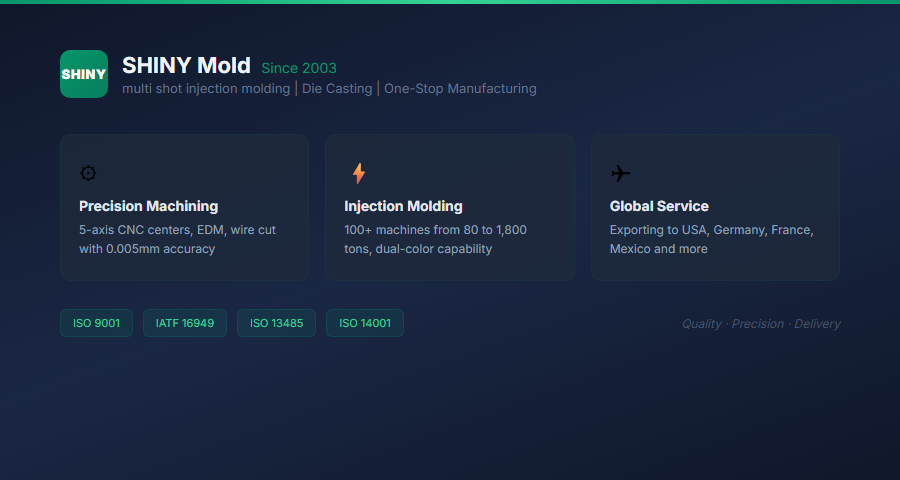
Founded in 2003, SHINY (Dongguan Xinxuan Mold) is headquartered in China's mould manufacturing hub — Chang'an, Dongguan. With fixed assets of USD 5 million, a facility spanning over 23,000 square metres, and a workforce of 400+ employees, SHINY specialises in high-precision plastic injection moulds, aluminium die-casting moulds, and magnesium die-casting moulds.
SHINY is IATF 16949:2016 certified for automotive quality management, with extensive experience in automotive interior and exterior components, under-hood parts, and EV battery housings. Our comprehensive library of 5,000+ mould designs and annual output of 2,000+ moulds demonstrates our capability to serve global automotive OEMs and Tier 1 suppliers.
With 100+ injection moulding machines (80–1,800 tons), dual-colour injection capability, and dedicated assembly lines, SHINY provides end-to-end automotive manufacturing from product design and prototyping to mould development, injection moulding, and finished product assembly. Our clients span the United States, Canada, Mexico, Germany, France, Poland, and other European and American markets.
Specialized Automotive Molding Technologies
Two-Shot (Dual-Color) Molding
Two-shot molding produces parts with two different materials or colors in a single cycle. Automotive applications include:
- Soft-touch buttons and controls
- Sealed connectors with integrated gaskets
- Interior trim with color contrast
- Multi-material instrument panel components
Overmolding
Overmolding bonds a second material over a substrate, creating parts with enhanced functionality:
- Grip surfaces on steering wheel components
- Seals and gaskets on housings
- Vibration dampening mounts
Glass-Fiber Reinforced Molding
Glass-filled materials (PA-GF30, PBT-GF30, etc.) provide enhanced strength and dimensional stability for structural automotive components. Key considerations:
- Higher injection pressure and wear on moulds
- Anisotropic shrinkage — requires careful mould design
- Surface finish considerations — glass fibers can cause visual defects
Cost Factors in Automotive Injection Molding
Tooling Cost (NRE)
- Mould complexity — Multi-cavity, side-actions, lifters increase cost
- Mould material — H13 or S136 for high-volume production durability
- Tolerance requirements — Tight tolerances require more precise tooling
- Cavity count — Higher cavities = higher tooling cost but lower piece price
Piece Price Factors
- Material cost — Engineering resins cost 2-5x more than commodity plastics
- Part weight — Larger parts require larger machines and more material
- Cycle time — Optimized cooling and process reduce cost
- Production volume — Higher volumes justify multi-cavity moulds
- Quality requirements — Automotive-grade parts require more inspection and documentation
How to Choose an Automotive Injection Molding Partner
- Verify IATF 16949 Certification
- Request current certificate and audit reports
- Verify scope includes injection molding
- Evaluate Automotive Experience
- Ask for case studies and customer references
- Review experience with similar parts (interior, under-hood, exterior)
- Assess Technical Capability
- In-house tool room with 5-axis CNC, EDM, wire cutting
- CAE simulation capability (Moldflow, Moldex3D)
- Range of injection machines (80-2000+ tons)
- Review Quality Systems
- PPAP capability and experience
- In-house CMM and testing laboratory
- SPC implementation and real-time monitoring
- Consider Supply Chain Factors
- Geographic location and logistics
- Lead time for tooling and production
- Secondary operations capability (painting, assembly)
2026 Trends in Automotive Injection Molding
Electric Vehicle (EV) Components
The EV revolution is creating new opportunities for injection molding:
- Battery housings — Large, structural parts with thermal management features
- Charging port covers — Weather-sealed, impact-resistant components
- E-drive housings — High-precision, thermally conductive materials
Lightweight Materials
Automakers continue to reduce vehicle weight for fuel efficiency. Material trends include:
- Long-fiber thermoplastics — Higher strength-to-weight ratio
- Chemical foaming — MuCell process for weight reduction without strength loss
- Bio-based materials — Sustainable alternatives for non-structural parts
Sustainable Manufacturing
Environmental responsibility is driving changes in automotive molding:
- Post-consumer recycled (PCR) content in non-critical parts
- Energy-efficient all-electric machines
- Closed-loop material recycling in production
Common Questions About Automotive Injection Molding
What certifications are required for automotive injection molding?
IATF 16949:2016 is the primary certification. ISO 9001 is the minimum, but IATF 16949 is mandatory for OEM supply. ISO 14001 (environmental) and ISO 45001 (safety) are increasingly expected.
What is the typical lead time for automotive moulds?
Production moulds: 10-16 weeks for standard complexity. Prototype/bridge tooling: 4-6 weeks. Complex multi-cavity moulds: 16-24 weeks.
What is the minimum order quantity (MOQ) for automotive parts?
For production parts, typical MOQ is 3,000-10,000 pieces per order. Low-volume production (500-3,000 pieces) is possible with aluminium tooling or shared-cavity moulds.
How are automotive parts validated?
Through the PPAP process, including dimensional inspection, material testing, performance testing, and production trial runs. PPAP Level 3 is the most common submission level.
What materials are used for under-hood automotive parts?
PA (nylon) with glass fiber reinforcement is most common for its heat resistance and chemical resistance. PBT is used for electrical components. PPS and PEEK are used for extreme-temperature applications.
Conclusion
Automotive injection molding is a specialized discipline that demands IATF 16949 quality systems, PPAP documentation, engineering-grade materials, and deep expertise in automotive applications. As the industry evolves toward electric vehicles, lightweight materials, and sustainable manufacturing, choosing the right molding partner becomes even more critical.
When evaluating automotive injection molding suppliers, prioritize IATF 16949 certification, proven automotive experience, in-house tooling capability, and robust quality systems. The success of your automotive project depends on a partner who understands the stringent requirements of the industry and delivers consistent quality at competitive cost.