
 Chinese
Custom Injection Molding: Precision Solutions for Your Manufacturing Needs in 2026
In today's competitive manufacturing landscape, custom injection molding has become the go-to solution for producing high-quality, precision plastic components at scale. Whether you're developing a new consumer product, an automotive component, or a medical device, custom injection molding offers the flexibility, efficiency, and cost-effectiveness that modern manufacturing demands.
This comprehensive guide explores everything you need to know about custom injection molding in 2026: the process, materials, design considerations, quality standards, and practical advice for selecting the ideal manufacturing partner for your project.
What Is Custom Injection Molding?
Custom injection molding is a specialized manufacturing process that involves designing and producing custom molds to create plastic parts tailored to specific customer requirements. Unlike standard injection molding, which may use off-the-shelf molds, custom injection molding begins with understanding your unique part geometry, material specifications, performance requirements, and production volume needs.
The custom injection molding process follows these key steps:
Design & Engineering — Collaborate with experienced engineers to optimize part design for manufacturability (DFM)
Mold Design & Fabrication — Create precision molds using advanced CNC machining, EDM, and welding techniques
Material Selection — Choose the optimal thermoplastic or thermoset material for your application
Production — Inject molten material into the custom mold under high pressure
Quality Control — Inspect parts using CMM, optical measurement, and functional testing
Assembly & Finishing — Apply secondary operations such as printing, coating, or assembly
Advantages of Custom Injection Molding
Design Flexibility
Custom injection molding enables complex geometries, undercuts, thin walls, and intricate details that would be impossible or cost-prohibitive with other manufacturing methods. Multi-cavity molds, family molds, and stack molds further enhance design possibilities.
Material Versatility
From commodity plastics like PP and PE to high-performance engineering resins like PEEK, PEI, and LCP, custom injection molding supports an extensive range of materials. Additive masterbatches, reinforcements, and fillers can be incorporated to achieve specific properties.
Cost-Effectiveness at Scale
While custom mold fabrication requires upfront investment, the per-part cost decreases dramatically as production volume increases. For runs exceeding 10,000 units, custom injection molding often delivers the lowest total cost compared to 3D printing, CNC machining, or urethane casting.
Consistent Quality & Precision
Modern custom injection molding achieves tight tolerances (±0.05mm or better) with excellent repeatability. Scientific molding principles, DOE (Design of Experiments), and SPC (Statistical Process Control) ensure consistent part quality throughout the production run.
Key Applications of Custom Injection Molding
Automotive & Transportation
The automotive industry relies heavily on custom injection molding for interior trim, exterior components, under-hood parts, and EV battery enclosures. Lightweighting initiatives drive demand for high-strength, lightweight plastic components that maintain structural integrity while reducing vehicle weight.
Medical & Healthcare
Custom injection molding produces critical medical components including surgical instruments, drug delivery devices, diagnostic equipment housings, and implantable device components. Cleanroom manufacturing under ISO 13485 certification ensures compliance with stringent medical regulations.
Consumer Electronics & Appliances
From smartphone cases and laptop bezels to washing machine panels and refrigerator liners, custom injection molding delivers the aesthetic quality, dimensional precision, and functional performance that consumer products demand.
Industrial & Power Tools
Power tool housings, industrial equipment enclosures, and machinery components benefit from the durability, impact resistance, and chemical resistance of custom injection molded parts.
About SHINY Mold
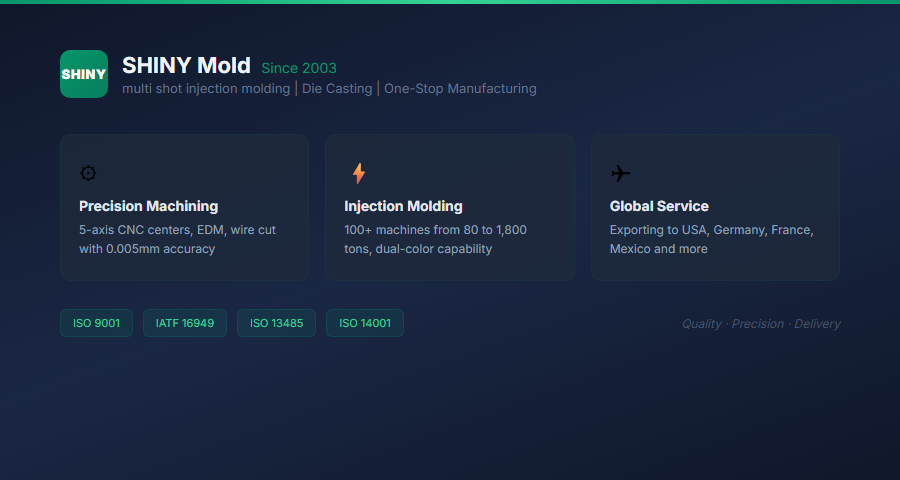
Founded in 2003, SHINY (Dongguan Xinxuan Mold) is headquartered in China's mold manufacturing hub — Chang'an, Dongguan. With fixed assets of USD 5 million, a facility spanning over 23,000 square meters, and a workforce of 400+ employees, SHINY specializes in high-precision plastic injection molds, aluminum die-casting molds, and magnesium die-casting molds.
Backed by a comprehensive library of 5,000+ mold designs, SHINY delivers over 2,000 molds annually. Our products serve industries including automotive, new energy, medical devices, consumer electronics, home appliances, power tools, and lighting. With 100+ injection molding machines (80–1,800 tons), dual-color injection capability, and dedicated assembly lines, SHINY provides end-to-end manufacturing from product design and prototyping to mold development, injection molding, and finished product assembly.
SHINY is certified under ISO 9001, ISO 14001, ISO 13485, and IATF 16949 quality management systems. Our clients span the United States, Canada, Mexico, Germany, France, Poland, and other European and American markets.
Material Selection for Custom Injection Molding
Choosing the right material is critical to part performance, cost, and manufacturability. Here's a comparison of commonly used materials in custom injection molding:
| Material | Key Properties | Typical Applications |
|---|---|---|
| ABS | Impact resistance, good surface finish | Consumer electronics, automotive interior |
| PC | Transparency, high impact strength | Safety glasses, automotive lenses |
| PP | Chemical resistance, living hinge capability | Food containers, battery cases |
| PA (Nylon) | High strength, wear resistance | Gears, bearings, automotive under-hood |
| POM (Delrin) | Dimensional stability, low friction | Precision gears, fuel system components |
| PBT | Electrical properties, chemical resistance | Connectors, sensor housings |
| PEEK | High temperature, chemical resistance | Aerospace, medical implants |
Design Considerations for Custom Injection Molding
Wall Thickness Uniformity
Maintaining uniform wall thickness minimizes warpage, sink marks, and internal stresses. Sudden changes in wall thickness should be avoided or gracefully transitioned using fillets and radii.
Draft Angles
Incorporating draft angles (typically 1-2° per side) facilitates part ejection from the mold and prolongs mold life by reducing wear on core and cavity surfaces.
Radii & Fillets
Sharp corners create stress concentration points prone to cracking. Generous radii (minimum 0.5mm, preferably 1.5× wall thickness) distribute stresses more evenly and improve mold fill.
Gate Location & Type
Gate location significantly affects part quality, weld line formation, and cosmetic appearance. Work with your molding partner to optimize gate location, size, and type (edge gate, submarine gate, hot tip gate, etc.) for your specific part geometry.
Quality Standards & Certifications
Reputable custom injection molding providers maintain rigorous quality management certifications:
ISO 9001:2015 — Quality management systems (foundational)
IATF 16949:2016 — Automotive quality management
ISO 13485:2016 — Medical device quality management
ISO 14001:2015 — Environmental management
UL Certification — Flammability and safety standards
2026 Trends in Custom Injection Molding
Industry 4.0 & Digital Manufacturing
Smart factories leverage IoT sensors, real-time process monitoring, AI-driven optimization, and digital twin technology to maximize efficiency, minimize defects, and enable predictive maintenance. These technologies reduce setup times, scrap rates, and energy consumption while improving overall equipment effectiveness (OEE).
Sustainable Materials & Circular Economy
Environmental responsibility is reshaping material selection and process design. Bio-based polymers, recycled content resins, and closed-loop recycling systems are gaining traction. Leading custom injection molders are setting ambitious sustainability targets and offering carbon-neutral manufacturing options.
Multi-Material & Overmolding
Two-shot molding, overmolding, and insert molding enable complex multi-material parts in a single cycle. These capabilities create soft-touch grips, integrated seals, and aesthetic contrasts while eliminating secondary assembly operations.
Rapid Tooling & Bridge Production
Advances in aluminum tooling, 3D printed mold inserts, and CNC machining speed reduce lead times for prototype and low-volume production. Bridge tooling strategies enable market testing and validation before committing to production-grade steel molds.
How to Choose the Right Custom Injection Molding Partner
Technical Capability & Equipment — Evaluate machine tonnage range, CAE simulation capabilities, cleanroom capacity, and secondary operation offerings
Quality Management & Certifications — Verify ISO 9001, IATF 16949, ISO 13485 certifications and review quality control processes
Industry Experience & References — Look for proven success in your specific industry and request customer references
Design & Engineering Support — Choose a partner who provides DFM feedback, mold flow analysis, and iterative design optimization
Production Capacity & Scalability — Ensure sufficient capacity for your current and future volume requirements
Communication & Project Management — Assess responsiveness, transparency, and project tracking capabilities
Cost Factors in Custom Injection Molding
Understanding cost drivers helps you optimize your project budget:
Mold Complexity & Cavitation — More cavities reduce per-part cost but increase mold cost
Material Selection — Engineering resins cost more than commodity plastics
Part Size & Wall Thickness — Larger, thicker parts require larger machines and longer cycle times
Tolerance Requirements — Tighter tolerances increase scrap rates and inspection costs
Surface Finish & Cosmetic Requirements — High-gloss or textured surfaces may require specialized mold finishes
Production Volume — Higher volumes justify more cavities and automation
Frequently Asked Questions
What is the typical lead time for custom injection molding?
Mold fabrication typically takes 4-12 weeks depending on complexity. For urgent projects, rapid tooling options can reduce lead time to 2-4 weeks. Production lead times depend on quantity, with typical turnaround of 2-4 weeks after mold approval.
What is the minimum order quantity (MOQ) for custom injection molding?
While there's no universal MOQ, most custom injection molders prefer runs of 1,000+ pieces to amortize setup and tooling costs. Some providers offer low-volume production (100-1,000 pieces) using aluminum tooling or shared cavities.
Can I get samples before full production?
Yes, reputable molders provide T1, T2, and production samples for approval. Rapid prototype tooling or 3D printing can also produce pre-production samples for form, fit, and function validation.
How do I ensure my parts meet specifications?
Work with a molder who provides first article inspection (FAI), in-process inspection, CMM reporting, and statistical process control (SPC). Material certifications, process validation, and PPAP documentation are standard for automotive and medical applications.
Conclusion
Custom injection molding remains the most versatile and cost-effective manufacturing method for producing high-quality plastic parts at scale. By partnering with an experienced, certified custom injection molding provider who combines advanced technology with proven quality systems, you can bring your product to market faster, more efficiently, and with superior quality.
Whether you're developing a simple consumer product or a complex automotive component, investing in the right custom injection molding partner is one of the most important decisions you'll make for your product's success.